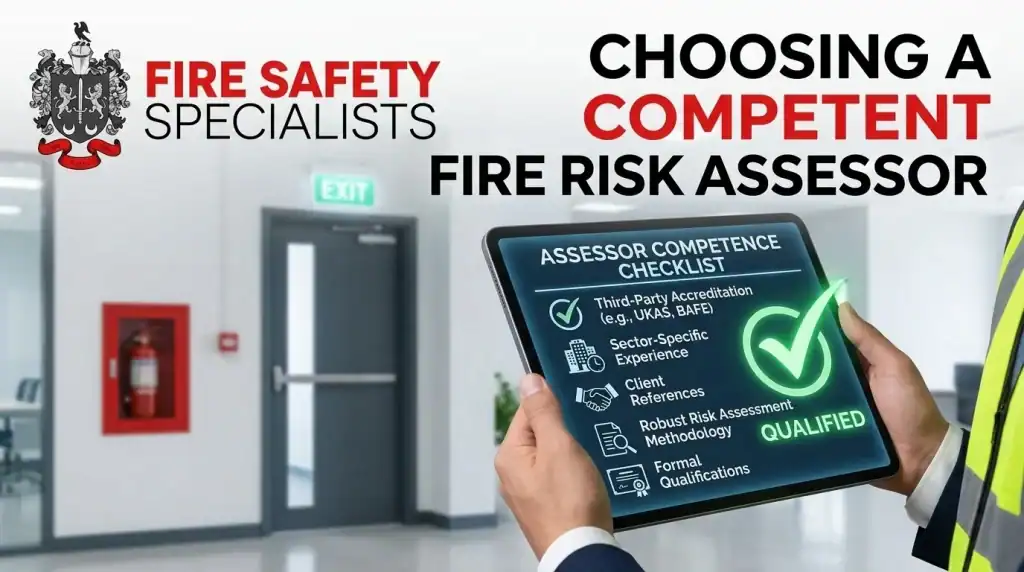
Choosing a competent fire risk assessor is one of the most important safety decisions you will make for your building. Under the Regulatory Reform (Fire Safety) Order 2005, a fire risk assessment must be suitable and sufficient. If it is not, the legal and safety consequences fall on you — not the assessor. That is why knowing how to choose fire risk assessor services properly matters.
Many businesses assume all fire risk assessors are the same. They are not. Qualifications, experience, accreditation, and report quality vary widely. This buying guide explains what to look for, how to verify competence, and how to apply competent person criteria in a practical way. By the end, you will know exactly how to make a confident and compliant appointment.
A fire risk assessment must meet legal standards. The Responsible Person has a duty to ensure the assessment is suitable and sufficient. Even if you employ an external assessor, the responsibility remains yours. If enforcement action is taken by the fire and rescue service, you must demonstrate that you took reasonable steps to appoint a competent professional.
An inadequate assessment can miss serious hazard risks. Poorly written reports often fail to prioritise actions or link recommendations to fire safety legislation. If your premises comply with the relevant legal requirement on paper but not in practice, the consequences can include enforcement notices, prosecution, or business disruption.
Choosing a competent fire risk assessor reduces risk in two ways. First, it improves fire safety standards in your building. Second, it protects you legally by showing that you followed guidance and applied due diligence. In both commercial and residential settings, that protection is invaluable.
The law does not define one single qualification that makes someone competent. Instead, it refers to competent person criteria. A competent person must have sufficient training, knowledge, and experience to properly assist with the assessment and fire safety measures.
In practical terms, competence includes:
Competence is not just about holding a certificate. Someone may qualify through training, but competence develops through real-world experience and ongoing professional development. When choosing a competent fire risk professional, always look beyond the certificate and assess the full picture.
Third-party accreditation is not legally mandatory. However, it is often one of the strongest indicators of quality and independent verification. Accredited FRA providers are assessed against recognised standards and audited to maintain compliance.
Below is a comparison to help you understand their value:
| Accreditation / Register | What It Confirms | Why It Matters |
| BAFE SP205 scheme | Company-level certification | Demonstrates quality systems and oversight |
| Professional body membership | Individual competence | Shows commitment to professional standards |
| Recognised assessor register | Verified competence level | Provides independent validation |
NFCC guidance and Fire Protection Association (FPA) advice both stress the importance of checking competence before appointing a fire risk assessor. Registers linked to recognised professional body organisations or the institute of fire safety managers provide added confidence.
While no scheme guarantees perfection, independent certification strengthens your decision and supports your compliance record.
Before appointing a competent fire risk assessor, carry out proper checks. This practical checklist helps you make a safe, compliant decision instead of relying on sales claims.
Ask for copies of relevant certificates and confirm the issue dates. Make sure the training relates directly to fire risk assessment and fire safety legislation, not just general health and safety.
Professional development shows the assessor keeps up with changes in law, guidance, and industry standards. Fire safety regulations evolve, and up-to-date knowledge is essential.
Ask whether they have carried out assessments on premises similar to yours — such as residential buildings, flats, offices, warehouses, or commercial sites. Experience should match the size, use, and complexity of your building.
Request a sample fire risk assessment report. Check that it is clear, prioritised, and practical. It should identify hazard levels, explain risks, and provide actionable recommendations.
Verify professional indemnity and public liability insurance. Adequate insurance protects both parties if errors or omissions arise.
Contact previous clients to confirm reliability, professionalism, and report quality. Honest feedback gives valuable insight.
Taking these steps builds confidence and helps ensure you appoint a competent specialist while reducing legal and safety risk.
In some simple premises, the Responsible Person may decide who should carry and carry out a fire risk assessment internally. This may apply to a small shop, house, or low-risk workplace. However, you must still meet the legal requirement to produce a suitable and sufficient assessment.
The moment your building increases in complexity — multiple floors, sleeping accommodation, high occupancy levels, or vulnerable occupants — specialist support becomes essential. Complex residential buildings and commercial sites require deeper technical knowledge of fire behaviour, evacuation strategy, and protection measures.
While cost is often a concern, using a specialist reduces long-term risk. A poor internal assessment can lead to enforcement action or unsafe conditions. In most cases, choosing a fire risk assessor with verified experience is the safer and more compliant option.
Price alone should never drive your decision. A very low quote often means limited scope or generic reporting. Instead, compare offers based on value and clarity.
Compare the following factors:
When you compare quotes, ask what is included and what is excluded. Some providers offer additional support in managing actions and ensuring compliance. That support can be critical for larger organisation settings.
The goal is not to find the cheapest option, but the most appropriate and compliant service for your premises. A thorough assessment to ensure the premises are safe and legally compliant delivers real value.
Choosing a competent fire risk assessor is about more than ticking a box. It is about protecting people, meeting your duty under fire safety legislation, and ensuring your building remains compliant.
Apply competent person criteria carefully. Verify qualifications, review experience, check insurance, and consider accredited FRA providers. Follow NFCC guidance and keep records of your decision process. When you choose fire risk assessor services based on quality and evidence, you build confidence, reduce legal exposure, and strengthen fire safety in your premises.
A fire risk assessor must demonstrate knowledge of fire safety legislation, hazard identification, evacuation principles, and risk evaluation. They should also show experience with similar premises and ongoing professional development.
A competent person is someone with sufficient training, knowledge, and experience to properly assess fire risk and recommend appropriate safety measures. Competence depends on the complexity of the building.
Yes. While not legally required, accreditation such as the BAFE SP205 scheme provides independent verification. Accredited FRA providers are assessed against recognised standards.
Request certificates, review CPD records, confirm insurance, examine sample reports, and contact previous clients. Independent registers and professional body listings can also help.
NFCC guidance recommends verifying competence. Recognised registers provide additional confidence that the assessor meets industry standards and independent oversight requirements.
You may also want to read:
How Much Does a Fire Risk Assessment Cost?
Hiring a Fire Protection Consultant: A UK Guide