Clear evacuation plans save lives. In any emergency, confusion causes delay. Delay increases risk. That is why every workplace, residential building, and public site must have structured emergency evacuation plans in place.
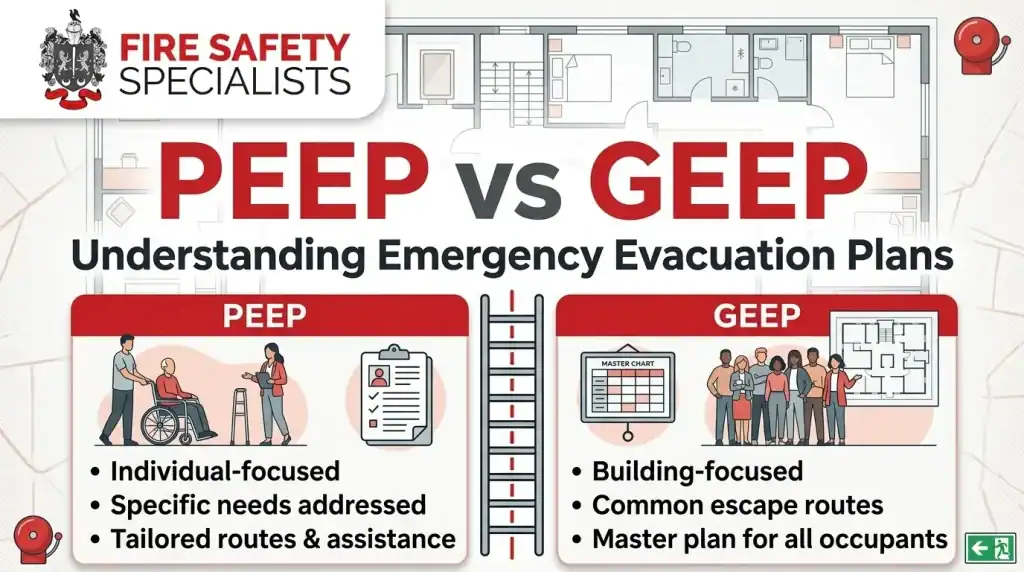
You may have heard the terms PEEP and GEEP. Many people mix them up. A general emergency evacuation plan (GEEP) covers everyone in a building. A personal emergency evacuation plan (PEEP) supports individuals who cannot evacuate safely without help. Understanding the difference between GEEPs and PEEPs is essential for fire safety, compliance, and inclusive evacuation.
This guide answers a key question: When is a GEEP appropriate instead of individual PEEPs? If you are a building owner, employer, or responsible person, this will help you make the right decision and meet your legal duty.
A general emergency evacuation plan is a structured plan designed for all building occupants. The purpose of a GEEP is to ensure that everyone knows how to evacuate the building safely in the event of an emergency. It outlines evacuation routes, escape routes, exits, emergency equipment, and roles such as fire wardens. It supports safe evacuation for all occupants through clear instructions and visible signage.
A GEEP is appropriate in workplaces where people can evacuate unaided. Offices, retail stores, warehouses, and schools often use a GEEP as their main workplace emergency plan. The plan must explain the building’s layout, communication devices used in an emergency, assembly points, and evacuation procedures. Regular drill practice ensures staff are aware of the procedures.
A GEEP is required by law under fire safety and health and safety duties. The Regulatory Reform (Fire Safety) Order places responsibility on the ‘responsible person’ to create arrangements for the safe evacuation of building occupants. A GEEP works well when the ability to evacuate is not restricted. If people can’t evacuate safely, then additional planning is needed.
A personal emergency evacuation plan is a personal plan designed for individuals who may not be able to evacuate without help. A PEEP is created to protect people who cannot evacuate safely or evacuate independently. Unlike a GEEP, it focuses on one individual and their specific needs.
You may need a PEEP if someone has mobility impairments, restricted mobility, visual or hearing impairments, or cognitive conditions. Temporary situations also matter. A broken leg, pregnancy, or short-term illness can affect someone’s ability to evacuate. If a person cannot evacuate unaided, they may require assistance through a structured PEEP.
A PEEP must detail how the person will reach a place of safety, what personal assistance is required, and what evacuation products such as evacuation chairs may be used. It must clearly define who will assist and how. If someone cannot safely evacuate in the event of a fire, relying only on a general evacuation plan is not enough.
PEEP vs GEEP often causes confusion, but the difference between GEEPs and PEEPs is straightforward. One plan covers the whole building. The other supports individuals who may need assistance during an emergency. A clear comparison makes it easier to understand which plan applies in your situation.
| Feature | GEEP | PEEP |
| Scope | Whole building | Individual |
| Designed For | All occupants | Individuals with specific needs |
| Customisation | Standard plan | Fully tailored |
| Legal Trigger | Required in most workplaces | Required when someone cannot evacuate unaided |
| Review | Annual or after changes | Reviewed regularly and updated frequently |
The difference between geeps and peeps is simple. A GEEP provides general evacuation guidance for all occupants. A PEEP is a plan for individuals who may require assistance. Both support fire safety, but they serve different roles. In practice, many buildings need both a peep and geep to ensure inclusive evacuation.
Choosing between a GEEP and individual PEEPs starts with one simple question: can everyone evacuate safely without help? This decision should be based on risk, legal duties, and the real ability of your staff to leave the building during an emergency. Use this practical framework to guide you:
If no one requires assistance and everyone can evacuate safely in the event of an emergency, a GEEP alone may be appropriate. However, if even one person cannot evacuate independently, you require a PEEP alongside your GEEP.
A general evacuation plan must do one thing well: guide people out quickly and safely during an emergency. It should remove confusion, give clear direction, and support safe evacuation for all occupants. Below are the essential elements every GEEP should include.
The plan must be easy to understand and used in an emergency without confusion. Clear structure reduces panic and supports safe evacuation.
Inclusive evacuation is not optional. It is part of ensuring fire safety and meeting equality act duties.
Some individuals may face greater risk during an emergency evacuation. These include:
If someone cannot safely evacuate, the plan must include clear support. This may involve evacuation chairs, personal assistance, alternative escape routes, or protected refuge areas.
Ask this simple question: When the alarm sounds, can the person evacuate the building unaided and reach a place of safety? If the answer is no, you require a PEEP. A GEEP alone does not protect people who cannot evacuate safely.
An emergency evacuation plan is only effective if it works under pressure. It must be clear, current, and tested in real conditions. Regular review helps ensure your GEEP and any PEEPs remain accurate, practical, and compliant with fire safety duties.
Follow this five-step maintenance plan:
Building managers and the responsible person must ensure compliance and document reviews. Best practice means not waiting for an incident to test your plan.
PEEP vs GEEP is not about choosing one over the other. It is about using the right tool for the right situation. A general emergency evacuation plan supports all building occupants. A personal emergency evacuation plan protects individuals who cannot evacuate safely without help.
Workplaces should create a GEEP as a baseline legal requirement. If anyone requires assistance, you must also create a PEEP. That approach ensures inclusive evacuation, meets equality act duties, and supports health and safety compliance.
Clear planning saves lives. The right evacuation plans reduce confusion, protect vulnerable individuals, and ensure everyone reaches a place of safety.
A GEEP covers all occupants and provides general evacuation procedures. A PEEP is tailored for individuals who cannot evacuate unaided and require assistance.
A GEEP is a general emergency evacuation plan designed for the whole building. It outlines exits, evacuation routes, emergency equipment, and roles such as fire wardens.
A PEEP is a personal emergency evacuation plan for individuals with specific needs. It details how they will evacuate safely, what assistance is required, and who will help.
Yes. A GEEP is required by law under fire safety regulations. A PEEP may also be required by law under the Equality Act 2010 if someone cannot safely evacuate without assistance.
Emergency evacuation plans should be reviewed regularly, at least annually, and updated after any significant change to building layout, occupancy, or staffing.
You may also want to read:
Differences Between GEEPs and PEEPs: A Comprehensive Guide
Residential PEEPs: A Complete Guide to Personal Emergency Evacuation Plans