Travel distance is one of the most misunderstood parts of a retail fire risk assessment. Many issues arise not because exits are missing, but because the escape route distance has been measured incorrectly or assumptions were made about usable exits. In retail settings, layout changes, shelving, tills, and storage often alter the true path of travel.
This guide by Fire Safety Specialists Ltd explains how to calculate travel distances correctly, when the main entrance can or cannot be discounted, and how to avoid common compliance failures.
This is one of the most common questions in Retail Fire Risk Assessments, and the answer is sometimes, not always.
The main entrance can only be discounted when it does not provide a safe or reliable means of escape during a fire. This decision must be based on risk, not convenience.
Discounting the main entrance without justification can result in underestimating travel distance and failing the assessment.
You may also read: Fire Safety Information Pack - New Duties Under the Building Safety Act 2022
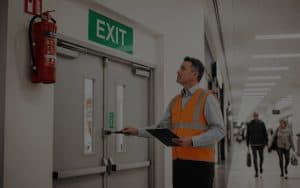
Travel distance must always be measured along the natural path of travel, not in a straight line.
This means following the actual walking route an occupant would use during evacuation, accounting for real conditions inside the building.
Key measurement principles include:
Furniture, storage units, promotional displays, and tills often extend the true distance. Ignoring these features is a common error that leads to non-compliance.
You may also read: Do Staff Need Fire Safety Training?
Maximum travel distance depends on the risk profile of the retail space and whether fire protection systems are present.
| Retail Risk Category | Typical Maximum Travel Distance |
| Low-risk retail (open plan, low fuel load) | Up to 45 m |
| Normal retail risk | Up to 30 m |
| Higher-risk retail areas | 18–25 m |
| Single direction of travel | Reduced limits apply |
These distances are influenced by fire safety guidance, occupancy, and layout. Codes such as NFPA 101 and local regulations may further adjust limits based on sprinklers and alarm systems.
You may also read: Managing Fire Signage and Decorations in Communal Areas
Alternative exits are required when a single escape route does not provide sufficient protection during a fire. This usually occurs when the travel distance to an exit exceeds the permitted maximum or when occupants can travel in only one direction, reducing evacuation options.
Another trigger is when a single exit could be compromised by fire, such as when the route passes close to higher-risk areas or combustible storage. If fire or smoke is likely to affect the route early, relying on one exit is unsafe.
Retail units can also become non-compliant after refits or layout changes that increase occupancy or extend travel distances. In these cases, adding a second exit or adjusting the layout is often the most effective solution.
You may also read: Does Every Commercial Building Need to Have a Fire Strategy?

Retail spaces change frequently, which makes travel distance easy to exceed without noticing.
Common issues include:
These issues usually develop over time, which is why regular review and inspection are essential.
You may also read: Path to Becoming a Fire Risk Assessor
If travel distance is not measured along the true escape route, the assessment is unreliable. Discounting exits without justification, ignoring layout changes, or assuming straight-line distances creates real risk. Travel distance should always reflect how people actually move in an emergency.
Correct travel distance calculation is about realism, not theory. Retail fire risk assessments must consider layout, occupancy, exit reliability, and how quickly conditions can change during a fire. When measured properly, travel distance supports safer escape route planning and stronger compliance with fire safety requirements and guidance such as those aligned with **Occupational Safety and Health Administration principles.
Egress travel distance is calculated by measuring along the natural walking route from the most remote point in the space to the nearest usable exit, following the actual layout and any obstacles.
The maximum travel distance depends on the level of risk, building layout, and fire protection measures. In most retail settings, it typically ranges between 18 metres and 45 metres.
Yes, a single exit may be acceptable if travel distance limits are met and the occupancy level and fire risk remain low.
Alternative escape routes are required when travel distance limits are exceeded, escape is possible in only one direction, or an exit could be affected by fire.
Common failures include ignoring furniture and storage, blocked exits, checkout layouts extending travel distance, and incorrectly discounting the main entrance.